2026-05-16

Awakening the Neural Niche: Auxetic Hydrogel Mechanics Dictate Schwann Cell Polarization and Remyelination


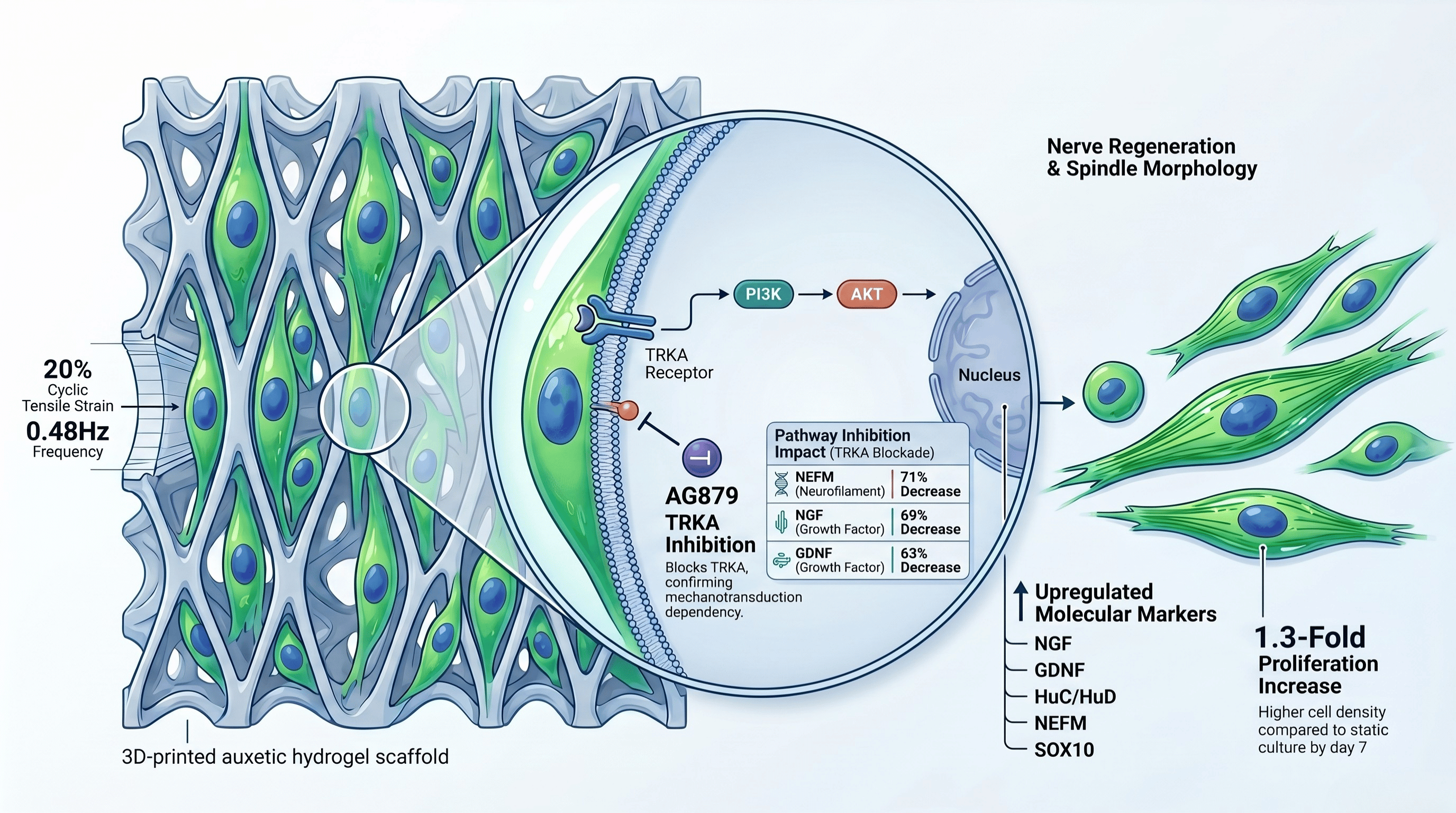
Peripheral nerve regeneration relies heavily on structural cues, yet conventional static cultures force cellular systems into a dormant, disorganized architecture. This physics-deprived silence sentences cells to an artifactual state that fails to capture their true therapeutic potential. By deploying a 3D-printed, auxetic FGelMa hydrogel to encapsulate human Schwann cells (hSCs) and applying a defined 20% cyclic stretch at 0.48 Hz, this dynamic paradigm transcends the limitations of rigid bioprinting. This controlled mechanical tension does not compromise structural integrity; instead, it establishes a kinetic microenvironment that orchestrates cellular alignment and drives a highly coordinated neuroregenerative cascade.

The Mechanobiological Translation: TRKA Activation without Pan-Receptor Sabotage
Subjecting encapsulated human neuroglia to this 0.48 Hz rhythmic pull for seven days accelerates proliferation to approximately 1.3-fold over static baselines, expanding the overall cellular coverage area. At the structural level, the isotropic energy transfer from the auxetic scaffold forces the cells to remodel their cytoskeleton, transitioning from disordered clusters into highly polarized, spindle-shaped morphologies aligned precisely with the axis of strain.

Mechanistically, the cell membrane receptors intercept this physical tension and selectively engage the TRKA receptor tyrosine kinase, phosphorylating and activating it without altering the expression of the pan-neurotrophin receptor p75NTR. This precise mechanotransduction event unleashes the downstream PI3K/AKT survival cascade, which simultaneously governs cytoskeletal elongation and drives the hyper-secretion of endogenous nerve growth factor (NGF). Concurrently, this signaling axis upregulates essential neurodevelopmental and regenerative proteins—including GDNF, HuC/HuD, NEFM, and SOX10—effectively executing the molecular blueprint for remyelination.

Overcoming Static Disorganization and Species-Specific Noise
The resolution of this dynamic platform is dual-fold, establishing its superiority over both traditional cultures and live animal models. While static control cells remain trapped in stochastic aggregates characterized by stagnant protein secretion and deficient growth kinetics, the introduction of cyclic stretch enforces highly organized, directional tissue patterning.

Furthermore, this system surpasses live animal models by positioning human hSCs at its core. In vivo peripheral nerve injury studies are routinely shrouded by high animal-to-animal variability, systemic endocrine interference, and evolutionary divergence. By stripping these compounding variables away, this platform isolates mechanical and biochemical synergy with absolute fidelity—offering a clear, human-relevant mechanistic readout that accelerates clinical translation for precision neuroprotection.


A static hydrogel merely permits encapsulated cells to subsist; only through pathologically calibrated, auxetic pulsation do human Schwann cells remodel their niche and betray the hidden molecular mechanics of neural repair.