2026-05-15

Deciphering Mechanotransduction in Vascular Inflammation


The Biophysical Blueprint
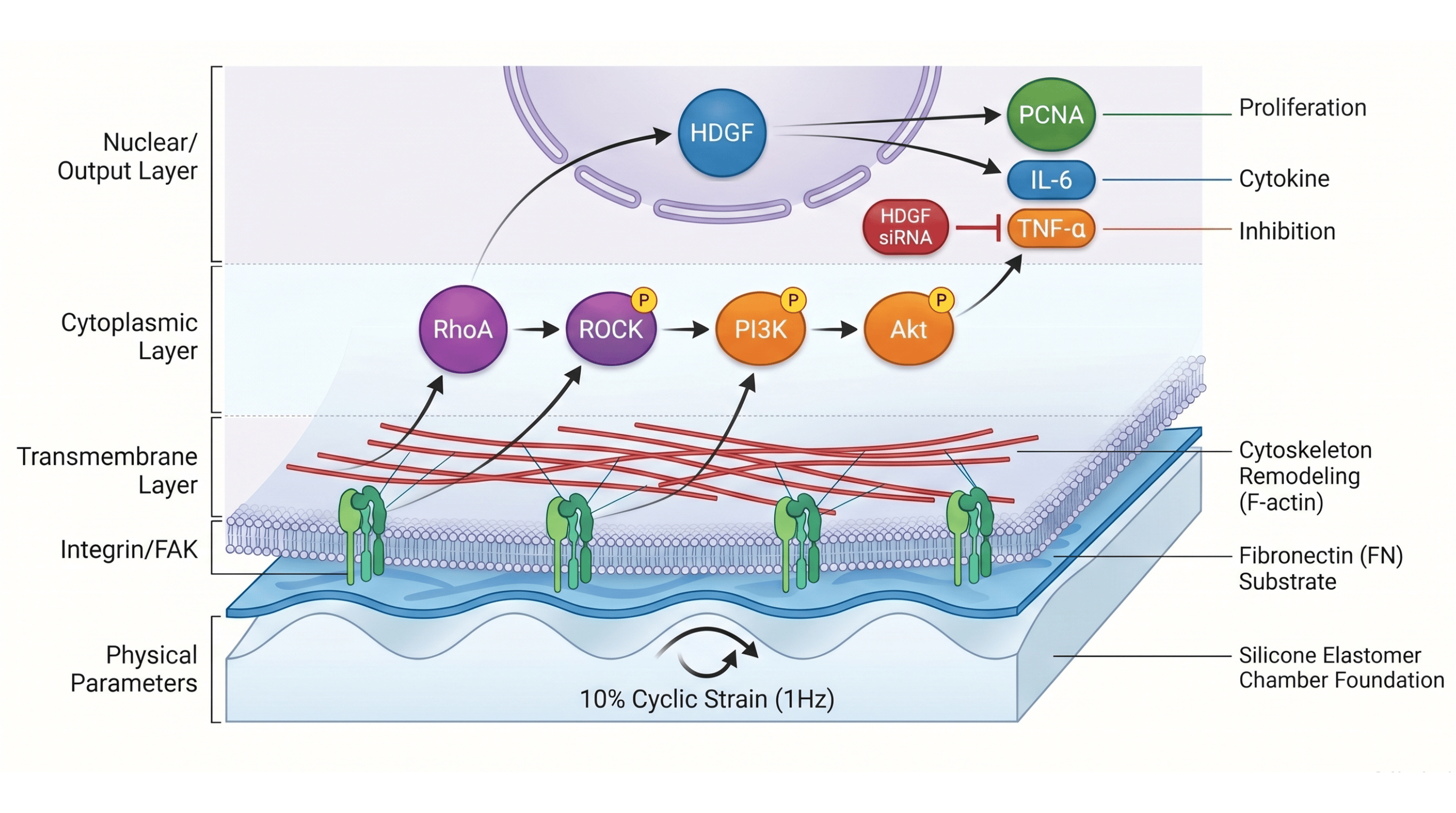
The study employs a 10% uniaxial cyclic stretch calibrated to a 1 Hz frequency (60 cycles per minute), precisely emulating the rhythmic hemodynamics of the human vasculature.

Core Mechanistic Findings
  • 
PI3K/Akt Orchestration: Mechanical tension activates the PI3K/Akt pathway, which subsequently governs the secretion of the pro-inflammatory cytokine TNF-. 

  • 
RhoA/ROCK Cytoskeletal Remodeling: This axis regulates structural reorganization via MBS phosphorylation. It acts as an upstream driver that triggers the overexpression of Hepatoma-Derived Growth Factor (HDGF) and the secretion of IL-6. 

  • 
Alarmin Signaling: Within this mechanical context, HDGF functions as a mechanically-evoked "alarmin," initiating the reparative and proliferative programs following vascular injury. 

Transcending Static 2D Constraints
Traditional static cell cultures suffer from a lack of physical tension, failing to mirror the authentic physiological responses of cardiovascular cells in vivo. This absence of mechanical stimuli often leads to a disconnect between in vitro observations and in vivo realities.
  • 
Structural Alignment: This technology overcomes the stochastic cellular orientation and stagnant growth dynamics inherent in static environments. 

  • 
Physiological Compensation: The introduction of dynamic stretch evokes a genuine survival response, inducing the proliferation marker PCNA while sustaining the constitutive expression of HDGF and pro-reparative cytokines like IL-6. 

Superiority over Animal Models: Precision and Control
While traditional investigations into vascular injury (such as balloon angioplasty or hypertension models) rely heavily on animal subjects, these in vivo systems are saturated with systemic "noise" from both internal and external environments.
  • 
Variable Isolation: This dynamic platform establishes a microenvironment characterized by high human-relevance. 

  • 
Causal Validation: By isolating mechanical force as a discrete variable, the study confirms that physical strain itself operates as a primary driver for the release of HDGF and inflammatory factors. 

While static Petri dishes merely allow cells to subsist, only by imparting biomimetic pulsations can we truly awaken the physiological essence of vascular cells.