2026-05-15

Mapping the Temporal Transcriptomics of Mechanical Overload


The Biophysical Blueprint
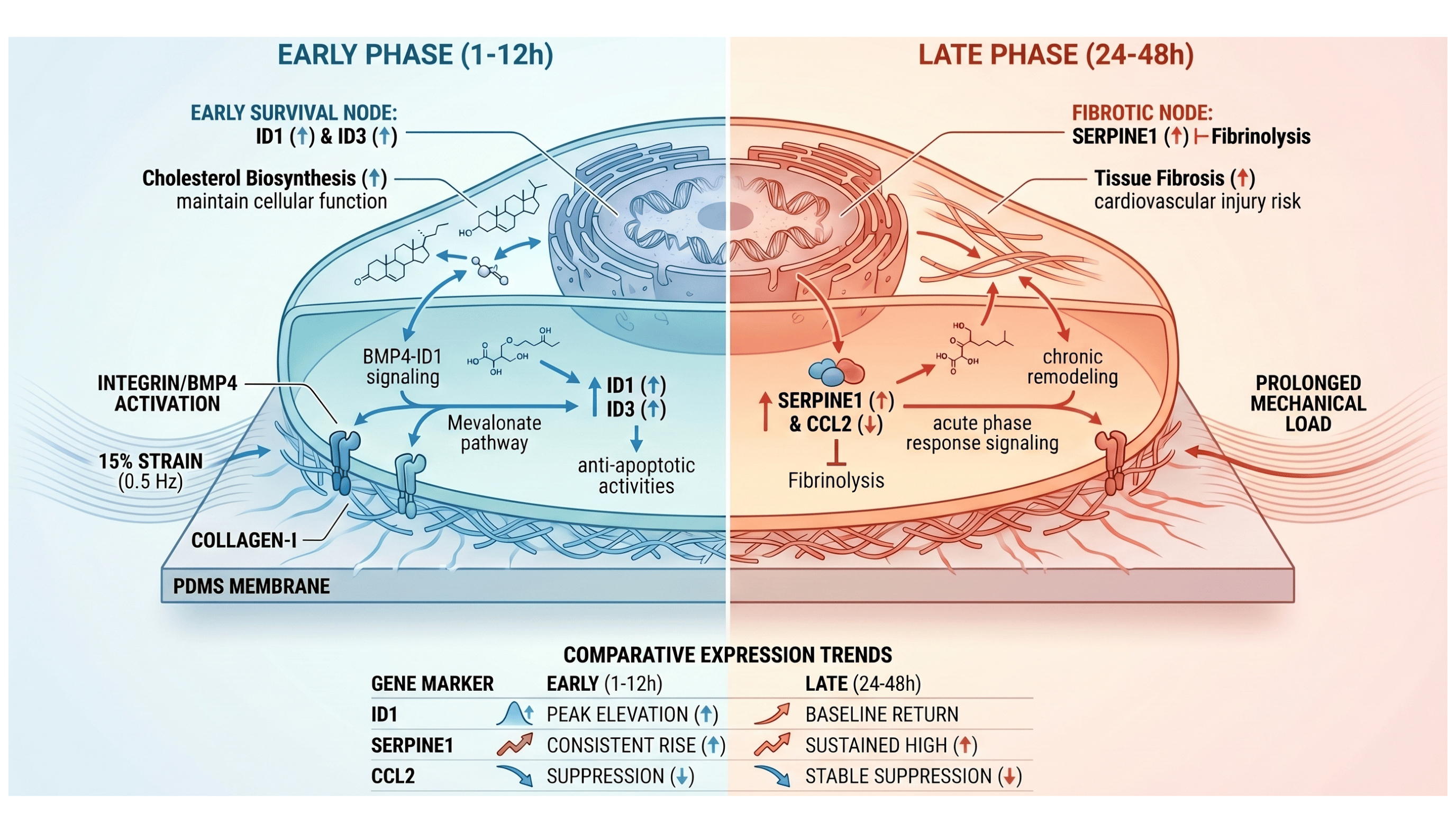
This investigation leverages Next-Generation Sequencing (NGS) to delineate how mechanical stress hacks the nuclear program. The experimental architecture implements a 15% uniaxial cyclic stretch at a 0.5 Hz frequency, capturing data across a longitudinal trajectory of 1, 4, 12, 24, and 48 hours.

Mechanistic Core: The Biphasic Genomic Evolution
  • 
Early Phase (1–12 hours): Metabolic and Survival Compensation: In the immediate aftermath of mechanical insult, cells activate the BMP4-ID1 signaling cascade and the cholesterol biosynthesis pathway. By upregulating ID1 and ID3 genes, the cardiomyocytes fortify an anti-apoptotic defense, attempting to sustain cellular function and viability under substantial physical tension. 

  • 
Late Phase (24–48 hours): Pathological Fibrosis and Inflammation: Beyond the 24-hour threshold, the mechanical defense shatters. The transcriptomic profile shifts abruptly toward tissue fibrosis and acute inflammatory responses. The significant upregulation of the SERPINE1 gene and altered CCL2 cytokine expression establish irreversible pathological ventricular remodeling. 

Transcending Static 2D Constraints
Conventional static environments suffer from a total absence of mechanical load, leaving human AC16 cardiomyocytes in a state of "physiological silence" where they fail to contract and eventually lose their characteristic morphology through spontaneous differentiation.
  • 
Functional Restoration: Integrating 15%–0.5 Hz dynamic stretch shatters this stagnation, compelling the cells to reveal their authentic transcriptomic responses to physical tension. 

  • 
Phenotypic Fidelity: This approach restores the load-response capacity of cardiomyocytes, as evidenced by the dynamic flux of ID1 and SERPINE1. 

Superiority Over Animal Models: Absolute Controlled Microenvironments
While in vivo models are frequently employed in cardiac pathology, they are saturated with systemic noise, including endocrine interference and immune cell signaling that affect multiple tissue types simultaneously.
  • 
Variable Extraction: By utilizing pure human ventricular cardiomyocytes (AC16), this platform isolates "pure physical stress" as a discrete variable. 

  • 
Causal Validation: The study confirms that mechanical stretch operates as an autonomous driver, capable of reorganizing cholesterol metabolism and triggering fibrosis without requiring systemic hormonal cues. 


Time functions as the invisible arbiter of cardiomyocyte fate. This research precisely maps the biphasic genomic trajectory of the heart under physical overload, tracing the transition from early metabolic survival to late-stage fibrotic collapse.