2026-05-15

Mechanobiology Hacks the Cellular Powerhouse to Drive Cardiac Hypertrophy


The Biophysical Blueprint

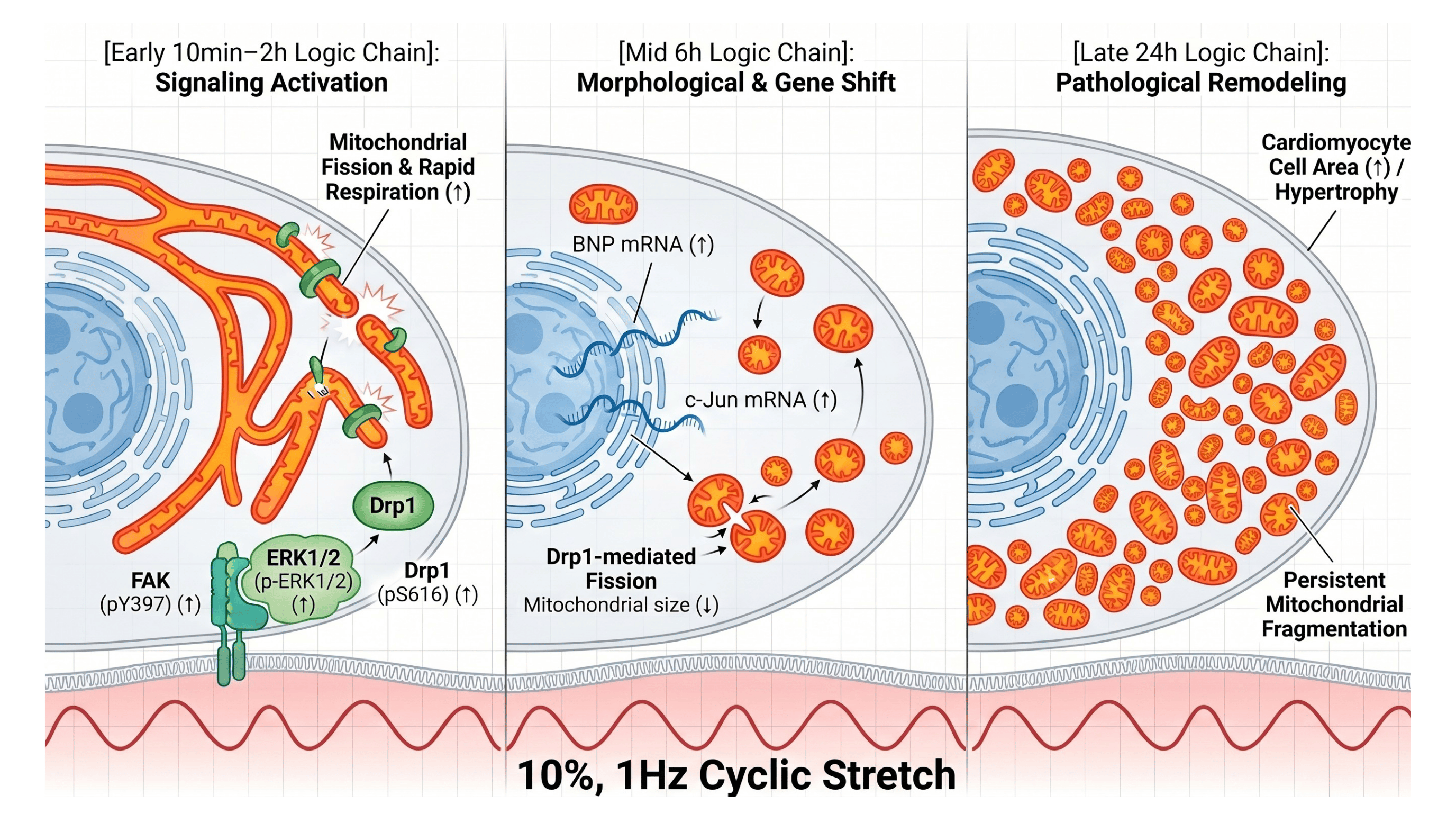
The experimental architecture implements a 10% uniaxial cyclic stretch calibrated to a 1 Hz frequency (simulating 60 beats per minute). Data collection across a longitudinal trajectory—10 minutes (early signaling), 6 hours (organelle remodeling), and 24 hours (cellular hypertrophy)—captures the progressive stages of mechanical adaptation.

Mechanistic Core: The FAK-Drp1 Bioenergetic Axis
  • Mechanical Sensing: Tension is sensed by Focal Adhesion Kinase (FAK), the cellular "mechanical clutch," which triggers immediate pY397 autophosphorylation.
  • Signal Transduction: Activated FAK orchestrates a signaling cascade through ERK1/2 kinases, which subsequently phosphorylate the mitochondrial fission protein Drp1 at the S616 site.
  • Early Phase (10 min–2 h): Physical traction ignites ERK1/2 activation and site-specific Drp1 phosphorylation.
  • Intermediate Phase (6 h): Phosphorylated Drp1 precipitates massive mitochondrial fission. This architectural shift reprograms Oxygen Consumption Rates (OCR) and ATP production to meet the energetic demands imposed by mechanical strain.
  • Late Phase (24 h): This mitochondrial-driven energetic recalibration propels a significant increase in cardiomyocyte volume, establishing the definitive cardiac hypertrophy phenotype.
Transcending Static 2D Constraints
Conventional static environments maintain neonatal rat ventricular myocytes (NRVMs) in a state of "mechanical silence," characterized by standard tubular mitochondrial networks and stable cell size.
  • Phenotypic Awakening: Integrating 10%–1 Hz dynamic stretch shatters this stagnation, compelling the cells to reveal their authentic temporal phenotypes in response to tension.
  • Biomimetic Fidelity: The platform transmutes simple physical pulling into a driver of cellular remodeling, mirroring the authentic responses of heart tissue under pressure overload.
Superiority Over Animal Models: Decoupling Mechanical Force from Systemic Noise
Investigations into ventricular hypertrophy frequently rely on animal models such as aortic banding. However, these in vivo systems are saturated with "sympathetic storms"—including adrenaline surges and systemic endocrine interference.
  • Variable Isolation: This dynamic platform establishes an absolute controlled microenvironment, isolating mechanical force as a discrete variable.
  • Causal Validation: The study confirms that purely physical stimuli are sufficient to remodel the cellular "power plant" and drive hypertrophy via the FAK-Drp1 axis, independent of systemic hormonal cues.

This research delineates the biophysical imperatives that transform mechanical overload into metabolic failure. By mapping the FAK-Drp1 axis, it demonstrates how the heart's "mechanical clutch" directly recalibrates mitochondrial energetics to fuel pathological growth.