2026-05-15

Mechanobiology of Vascular Failure Under Hypertensive Shock


The Biophysical Blueprint

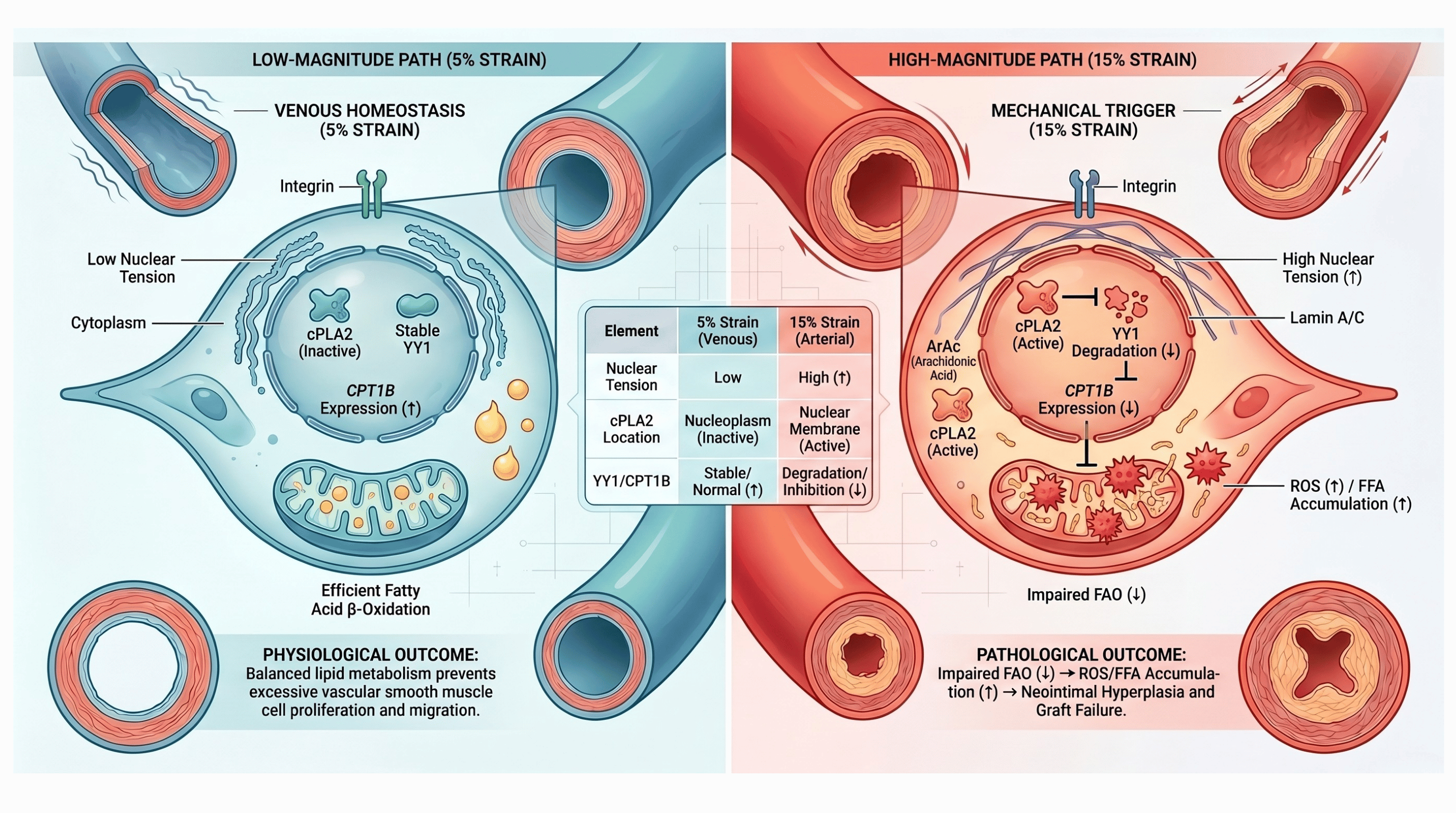
The experimental framework implements a 15% uniaxial cyclic stretch to replicate the acute hypertensive strain encountered when a vein is integrated into the arterial system, contrasted against 5% strain representing native venous physiological low pressure. The frequency is calibrated to 1 Hz (60 cycles per minute), precisely synchronizing with the human cardiac rhythm.

Mechanistic Core: The cPLA2-YY1-CPT1B Feedback Loop

 
  • Hemodynamic Shock: During coronary artery bypass grafting (CABG), the venous graft encounters an instantaneous pressure surge from 0–30 mmHg to as high as 150 mmHg. This 15%–1 Hz dynamic platform reconstructs this hemodynamic cataclysm, compelling venous smooth muscle cells (VSMCs) to reveal their pathological responses to mechanical tearing.
  • Mechanotransduction: Physical tension activates the nuclear protein cPLA2, which subsequently liberates arachidonic acid (ArAc).
  • Metabolic Recalibration: ArAc induces the degradation of the transcription factor YY1, leading to a precipitous decline in CPT1B expression. This molecular collapse extinguishes fatty acid β-oxidation (FAO).
  • Pathological Phenotype: The resulting accumulation of fatty acids triggers lipotoxicity and a surge in reactive oxygen species (ROS), driving VSMCs toward aggressive proliferation.
Comparative Divergence: Establishing Causal Rigor
  • Static vs. Physiological 5%: Cells maintained under static or 5% strain sustain lipid metabolic homeostasis, confirming that "15% hypertensive stretch" is the autonomous driver of metabolic failure.
  • Refining Animal Model Insights: While in vivo models, such as the murine carotid artery cannula, provide clinical context, they are saturated with "systemic noise" from thrombosis and endocrine interference. This in vitro platform isolates "15% physical stretch" as a discrete variable, proving that pure mechanical force independently dismantles the cPLA2-YY1-CPT1B axis.
  • Self-Amplifying Feedback: The study uncovers a destructive feedback mechanism where the unsaturated fatty acids accumulated from FAO inhibition recoil to further distend nuclear membrane tension, locking cPLA2 into a state of runaway activation.

By distilling the complexity of CABG into a single-cell biophysical model, this research identifies a vicious cycle between nuclear membrane tension and metabolic collapse. This discovery validates a highly efficient translational strategy: a mere 30-minute ex vivo "priming" with cPLA2 inhibitors or gene vectors can successfully abrogate intimal hyperplasia before implantation.