2026-05-15

Mechanostimulation Deciphers the Causal Logic of Vein Graft Failure


The Biophysical Blueprint

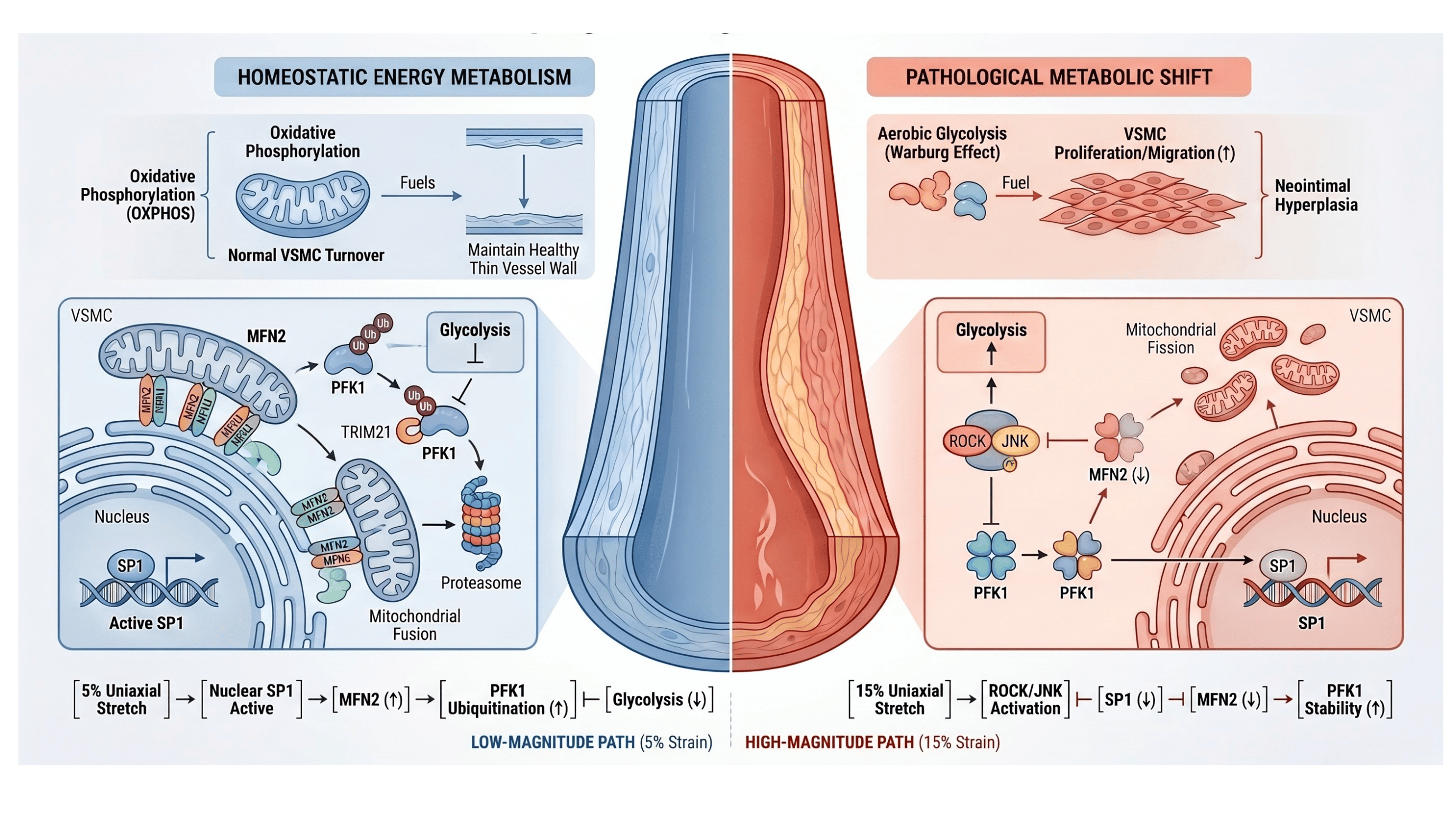
This investigation implements a 15% uniaxial cyclic stretch to replicate pathological arterial hypertension, contrasted against 5% strain or static conditions representing venous physiological low pressure. The frequency is precisely calibrated to 1 Hz (60 cycles per minute), effectively mimicking the rhythmic pulse of a resting human heart.

Mechanistic Core: The Metabolic Switch to Aerobic Glycolysis
  • 
Hemodynamic Shock: The 15% strain at 1 Hz precisely reconstructs the "physical shock" encountered in coronary artery bypass grafting (CABG), where a vein is abruptly subjected to a pressure surge from 0–30 mmHg to over 120 mmHg. 

  • 
Metabolic Recalibration: Under this extreme biomimetic tension, physical traction propels vascular smooth muscle cells (VSMCs) to shift from mitochondrial oxidative phosphorylation (OXPHOS) to aerobic glycolysis (the Warburg effect) to fuel pathological proliferation. 

  • 
The ROCK/JNK-MFN2 Axis: Mechanical strain activates intracellular ROCK and JNK kinases, which phosphorylate the transcription factor SP1 and shuttle it out of the nucleus. This nuclear exit extinguishes the expression of the mitochondrial fusion protein MFN2. 

  • 
Enzymatic Escape: The depletion of MFN2 ruptures its physical binding with the glycolytic rate-limiting enzyme PFK1. Consequently, PFK1 escapes degradation by the E3 ubiquitin ligase TRIM21. The resulting accumulation of PFK1 ignites full-scale glycolysis, driving the cells toward aggressive proliferation and migration. 

Transcending Static 2D and Physiological Constraints
In conventional static environments or 5% physiological stretch, VSMCs maintain stable MFN2 expression and remain in a quiescent state powered by normal oxidative phosphorylation.
  • 
Breaking Mechanical Silence: Integrating 15%–1 Hz dynamic stretch shatters the "mechanical silence" of static cultures, compelling the cells to undergo metabolic failure. 

  • 
Biomimetic Fidelity: This transition induces the massive production of the glycolytic intermediate fructose-1,6-bisphosphate (F-1,6-BP), confirming that high-pressure dynamic tension is the absolute requirement to replicate the metabolic landscape of intimal hyperplasia in vitro. 

Superiority Over Animal Models: Refining Variable Isolation
While in vivo models, such as murine carotid artery bypass, are traditionally utilized, they are saturated with "systemic noise" including thrombosis, immune infiltration, and endocrine interference.
  • 
Absolute Variable Extraction: This dynamic platform isolates "15% mechanical stress" as a discrete variable, proving that physical stretch alone is sufficient to dismantle the MFN2-PFK1 axis. 

  • 
Clinical Translation: This in vitro discovery guides a highly efficient translational strategy: a 30-minute ex vivo "priming" of the vein (using Ad-MFN2 gene vectors or PFK1 inhibitors) abrogates intimal hyperplasia in vivo. 


By stripping away the systemic noise of living organisms, this high-fidelity dynamic platform translates a century-old surgical challenge into a "therapeutic codebook" solvable in a mere 30-minute pre-operative window.