2026-05-15

Potentiating Myocardial Regeneration via dUBM-Mediated Mechanotransduction


The Biophysical Blueprint

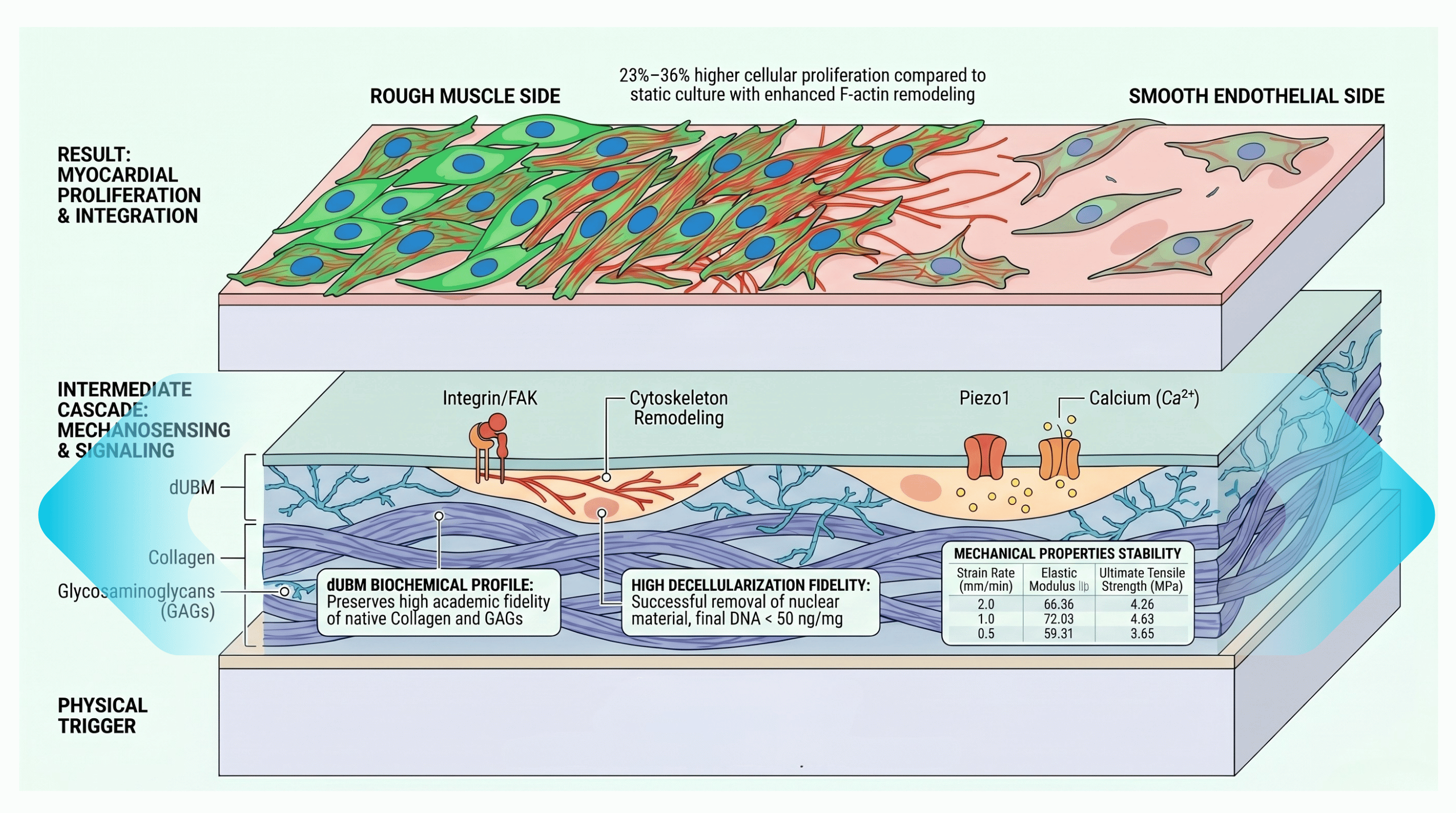
This investigation implements a 20% strain magnitude through periodic mechanical stretching at a 0.5 Hz frequency. This regimen precisely simulates the localized tissue distension and relaxation inherent in a beating heart. To capture the longitudinal effects on cellular behavior, the study establishes a continuous culture trajectory of 1, 3, and 7 days.


Mechanistic Core: The Bio-Elastic Interface
  • 
Extracellular Matrix Preservation: The decellularized porcine urinary bladder matrix (dUBM) retains essential architectural components, specifically collagen and glycosaminoglycans (GAGs). 


  • 
Dynamic Scaffolding: Under cyclic tension, this elastic natural substrate functions not as a passive vessel but as a dynamic mechanotransductive plate. 


  • 
Cytoskeletal Reconfiguration: The physical deformation of the dUBM compels attached cardiomyocytes to reorganize their F-actin cytoskeleton, facilitating complete cellular extension. 


Transcending Static 2D Constraints
Conventional static environments suffer from a total absence of physical tension, leaving cardiomyocytes in a state of metabolic subsistence where they merely "survive".

  • 
Proliferative Awakening: Integrating 20%–0.5 Hz dynamic stretch potentiates cellular growth. By the seventh day, the proliferation rate of cardiomyocytes in the dynamic group outpaces the static control by 23% to 36%. 


  • 
Ionic Activation: The dynamic system amplifies calcium signaling, with calcium ion concentrations in the supernatant significantly exceeding those of static cultures within 24 hours. 


  • 
Functional Restoration: These findings confirm that static environments suppress growth potential and ion channel activity, whereas dynamic stretch arouses latent physiological functions. 


Superiority Over Animal Models: Refining Human Relevance
Traditional evaluations of cardiac patches rely on in vivo models, which are frequently saturated with systemic "noise," including complex immune rejection, systemic inflammation, and hemodynamic variability.

 
  • 
Minimizing Immunological Interference: By utilizing human AC16 cardiomyocytes and dUBM that has undergone rigorous decellularization (removing nuclei and DNA), this platform curtails immunological interference. 


  • 
Absolute Variable Isolation: This in vitro platform isolates mechanical stress as a discrete variable. It validates that physical tension itself operates as an autonomous driver of cardiomyocyte proliferation and calcium release, independent of systemic inflammatory cues. 


Under a 0.5 Hz biomimetic pulsation, the dUBM transforms into a "dynamic resonance board." This system successfully transmits physical strain to awaken the regenerative potential of the cardiomyocyte.