2026-05-15

Recalibrating Cardiomyocyte Homeostasis via Mechanotransduction


The Biophysical Blueprint
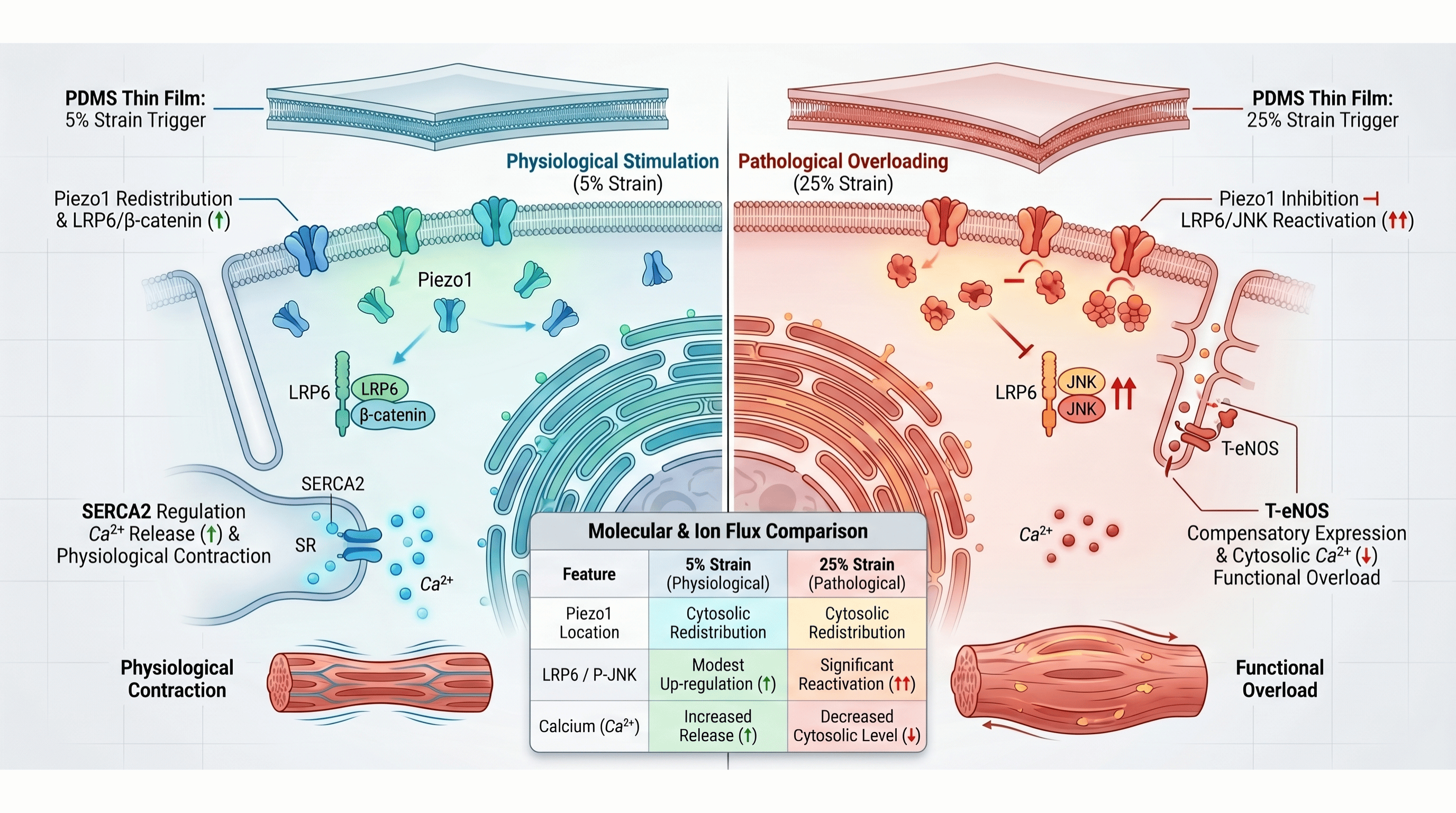
The experimental framework utilizes a 1 Hz frequency (60 cycles per minute) to deliver two distinct strain magnitudes: 5% elongation to replicate physiological steady-state and 25% elongation to simulate the pathological tension characteristic of hypertension or ventricular overload.

Mechanistic Core: The Piezo1 Gateway
  • 
Spatial Reconfiguration: Physical stimuli trigger a mechanotransduction pathway spearheaded by Piezo1, a mechanosensitive ion channel. Stretching propels Piezo1 from its perinuclear sequestration to a uniform distribution across the cytoplasm. 

  • 
Ionic Governance: This spatial redistribution recalibrates intracellular calcium flux, maintaining ionic equilibrium. 

  • 
Physiological Homeostasis (5% Strain): At this magnitude, cardiomyocytes achieve highly ordered alignment. Piezo1 governs calcium dynamics to sustain stable eNOS expression, mirroring the physiological stability of a healthy heartbeat. 

  • 
Pathological Compensatory Burst (25% Strain): Excessive tension ignites a surge in Wnt/JNK signaling. Termed a "reactivation effect," this represents a final compensatory maneuver by cardiomyocytes to salvage total eNOS production and preserve contractile function against physical overload. 

Overcoming the "Phenotypic Silence" of Static 2D Culture
Conventional static environments sequester Piezo1 proteins near the nucleus, leading to aberrant cytosolic calcium accumulation and a total loss of physiological ionic dynamics.
  • 
Functional Restoration: Integrating 5% biomimetic stretch reinstates Piezo1 distribution and potentiates the temporal profile of calcium release. 

  • 
Bridging the Blind Spot: This dynamic approach rectifies the fundamental inability of static cultures to simulate Excitation-Contraction Coupling. 

Superiority Over Animal Models: Refining Human Relevance
Traditional investigations into ventricular hypertrophy rely on animal models (such as ISO-induced myocardial injury in rats), which are often saturated with systemic noise and inter-individual variability.
  • 
Variable Isolation: Utilizing human AC16 cardiomyocytes, this platform isolates "pure physical tension" from systemic endocrine or neural interference. 

  • 
Predictive Rigor: The system demonstrates that under 25% extreme overload, pharmacological interventions fail to abrogate functional decline. This underscores the platform’s capacity to displace costly and complex animal models in high-fidelity drug screening. 

While static vessels stifle the rhythmic essence of the heart, a 1 Hz biomimetic pulsation awakens the Piezo1 mechanical radar, liberating the cardiomyocyte's innate capacity for calcium governance. The divergence between 5% and 25% strain defines the absolute threshold between physiological conditioning and pathological destruction; when mechanical defenses shatter, the surge of Wnt and JNK signals remains the cell's final, desperate compensatory refrain.