2026-05-16

Unlocking the Kinetic Niche: Cyclic Stretch Overcomes Mechanical Dormancy to Fuel Exosome Biogenesis.


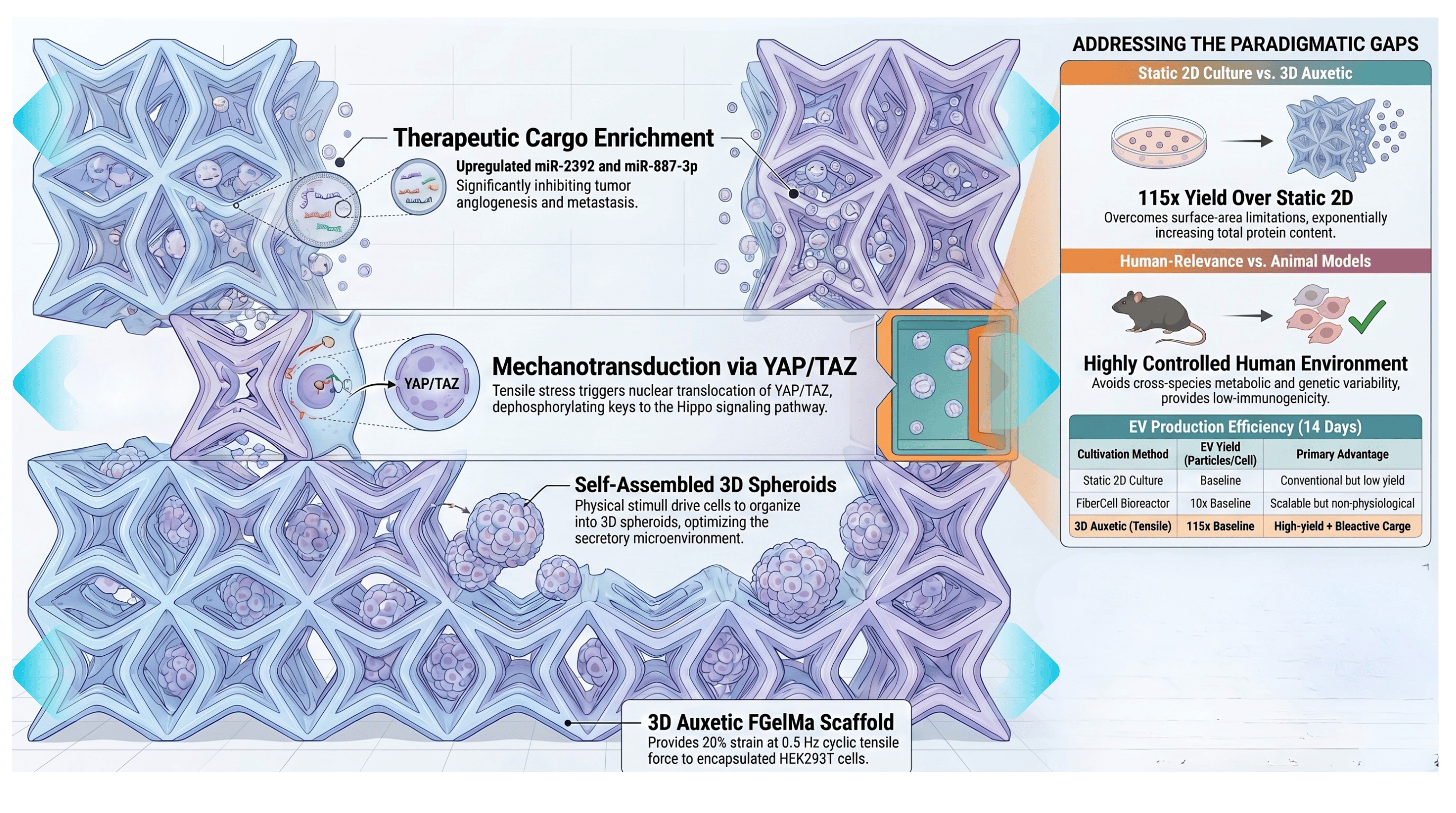
Conventional bio-manufacturing and cellular modeling remain largely constrained by rigid, two-dimensional static systems that sentence cells to an artifactual, physics-deprived silence. This methodological restriction induces a state of "mechanical dormancy," yielding non-physiological phenotypes and severely limiting the production of biopharmaceuticals. By engineering a dynamic microenvironment that applies a precise 20% cyclic stretch at 0.48 Hz—particularly within high-stiffness (G15) scaffolds—this approach disrupts conventional culture boundaries. This kinetic platform effectively extracts physical force as a discrete orchestrator, transforming physical tension into a robust neuroregenerative and therapeutic program.

The Mechanotransduction Circuit: YAP/TAZ Dephosphorylation and 3D Metamorphosis
The conversion of periodic tensile strain into cellular reconfiguration follows a highly coordinated spatial and molecular hierarchy. Cellular mechanoreceptors intercept the continuous physical pulling, bypassing the Hippo signaling pathway to force the dephosphorylation and subsequent nuclear translocation of YAP and TAZ. Once localized within the nucleus, these companion transcription factors function as the primary molecular "switches" that govern cell proliferation and trigger massive extracellular vesicle (EV) biogenesis.

Simultaneously, this dynamic force alters the spatial distribution of mechanical energy within the system, driving the intensive polymerization and remodeling of the F-actin cytoskeleton. This structural tension compels human embryonic kidney (HEK293T) cells to abandon their stochastic, scattered alignment and self-assemble into highly organized 3D spheroids exceeding 100 µm in diameter. This morphological transformation successfully recapitulates the complex three-dimensional interactions of native tissues, optimizing the homeostatic niche.

Transcending the Static Artifact: Exponential Yield and Oncological Reprogramming
The superiority of this dynamic 3D platform over traditional static 2D cultures is dual-fold, resolving the chronic bottlenecks of yield and therapeutic fidelity. Under static conditions—even within 3D matrices—mechanosensitive proteins remain inert. Introducing the 0.48 Hz, 20% cyclic strain abruptly shatters this latency, driving an exponential surge in exosome yield that reaches a remarkable 115-fold increase over flat static baselines.

More tellingly, this controlled mechanical strain selectively reprograms the molecular cargo of the secreted exosomes. The dynamic physical stress specifically upregulates anti-cancer microRNAs, including miR-2392 and miR-887-3p, enriching the vesicles with a potent phenotype capable of suppressing tumor proliferation and metastasis—a sophisticated functional profile that standard static platforms simply cannot spontaneously generate.


A static substrate merely permits cells to subsist; only through pathologically calibrated, dynamic pulsation do cellular sheets awaken their mechanical machinery, rewriting their transcriptomic cargo to unveil unprecedented therapeutic windows.