2026-05-15

Vitamin D as a Molecular Buffer Against Mechanically-Induced Endothelial Transformation


The Biophysical Blueprint
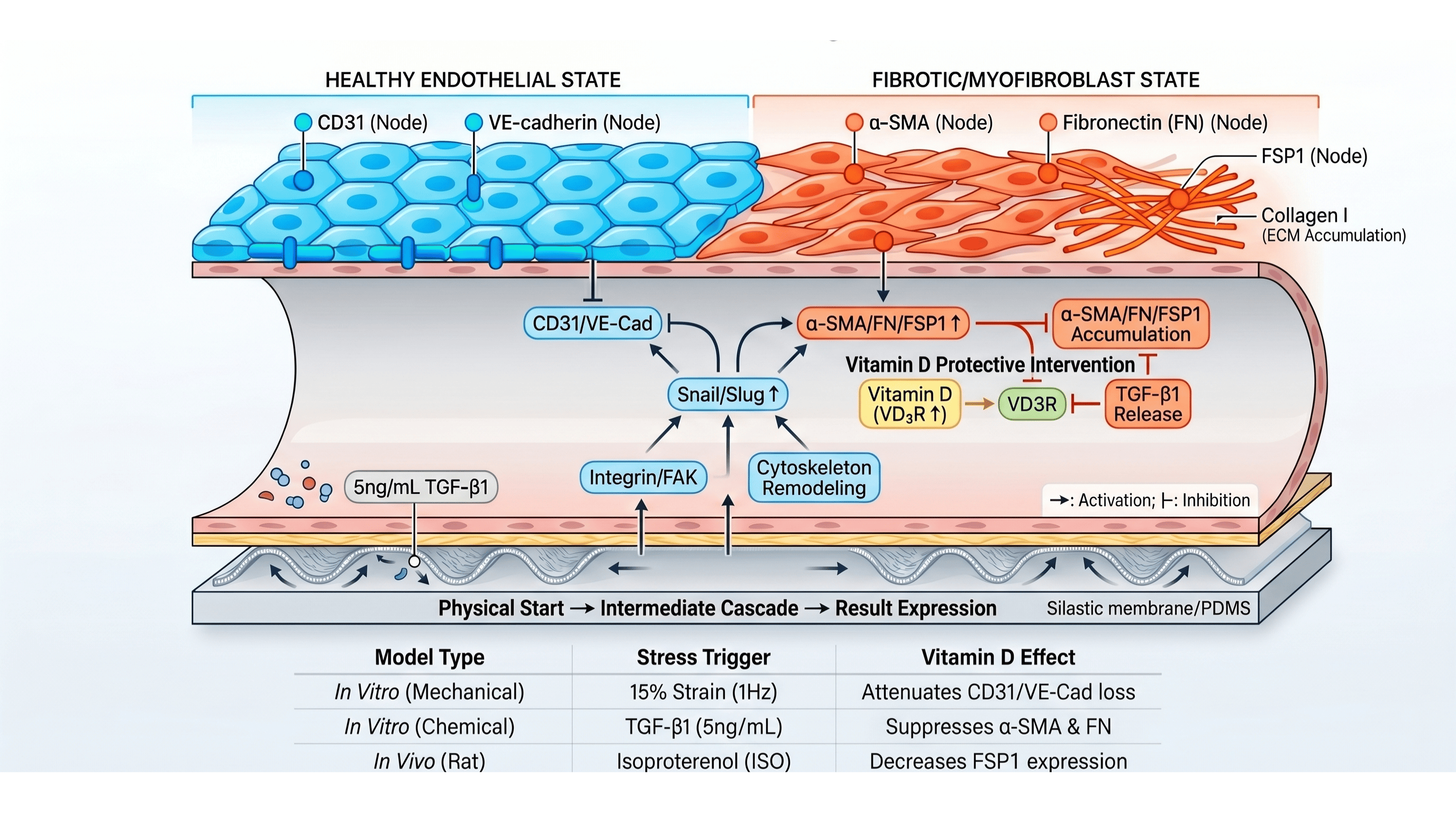
The study implements a 15% uniaxial cyclic stretch calibrated to a 1 Hz frequency over a 6-hour duration. This magnitude emulates the severe mechanical strain associated with hemodynamic overload.

Mechanistic Core: The Endothelial-to-Mesenchymal Transition (EndoMT)
  • 
Structural Disruption: High-intensity physical traction ruptures the inter-endothelial adhesion complexes. This mechanical insult precipitates a significant decline in the expression of VE-cadherin and CD31. 

  • 
Profibrotic Signaling: Mechanical tension liberates TGF-β from the microenvironment, which propels the classical EndoMT pathway. 

  • 
Phenotypic Shifting: Under this strain, cells transition toward a mesenchymal state, depositing pro-fibrotic matrices such as α-smooth muscle actin (α-SMA) and fibronectin. 

  • 
Vitamin D Intervention: Administration of 1nM Vitamin D attenuates the release of TGF-β and preserves VE-cadherin levels, albeit partially. 

Comparative Divergence: Static vs. In Vivo Models
  • 
Static Limitations: Conventional static cultures fail to replicate the barrier rupture induced by hypertensive overload. Conversely, this dynamic model establishes physical tension as a self-sufficient driver of EndoMT. 

  • 
Animal Model Complementarity: While ISO-induced rat models manifest macroscopic tissue fibrosis (indicated by increased FSP1), they lack the granularity to isolate cellular drivers. This in vitro dynamic platform furnishes microscopic evidence that the protective mechanism of Vitamin D is not mediated by systemic networks but operates directly upon the endothelial cells subjected to mechanical strain. 

While Vitamin D does not act as a "magic bullet" to reverse ventricular remodeling, it exhibits the potential to function as a fundamental defensive shield. By buttressing the VE-cadherin barrier and buffering the TGF-β-mediated inflammatory storm, it safeguards cellular integrity against extreme physical overload.